_signals_aggr collection and returns updated boost weights for the items in the main query’s search results. Items that have received more user interaction also receive higher boost weights.
See Recommendation Methods for more information.
This stage supports asynchronous processing.
Configuration overview
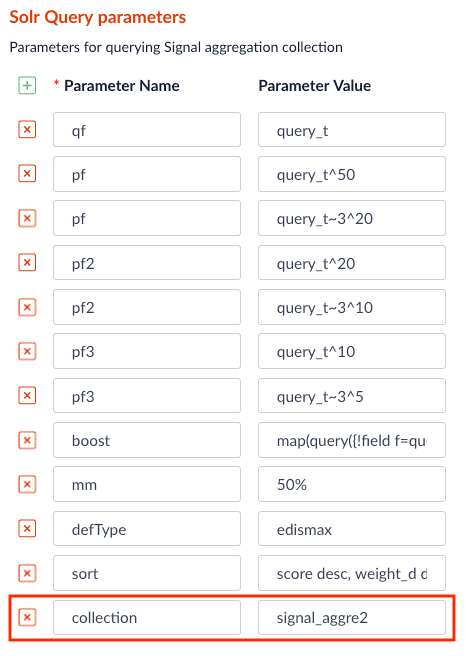
The fields below are especially useful to understand when configuring this stage.Solr query parameters
These parameters are used in the Solr Query parameters/queryParams field for retrieving signal aggregation docs from the _signals_aggr collection. These Solr query params will affect which aggregated signals are used for producing the boosting parameter on the main query.
FAQs
If there isfq in the main query, how is it matched with the correct aggregated signal?
In this case, you need to use the lw.rec.fq query parameter in the main query. lw.rec.fq can be parsed by the Boost with Signals stage, and therefore the filters specified in it can be added to the Solr query that is retrieving the aggregated signals.
For example, if we have filter query param fq=format:CD&fq=name:Latin, this needs to be translated into lw.rec.fq=filters_s:"format:cd $ name:latin". Values must be lowercase. The final main query should be:
If there are multiple
fq values (for example, format:cd and name:latin), they are ordered alphabetically as strings and joined with ” with a space on each side). In the example, "format:cd $ name:latin".collection parameter in the Solr Query Parameters section.