{isLoaded && `
}} />}
Powered by Lucidworks Agent Studio
;
};
[localhost link]: http://localhost:3000/docs/5/fusion/reference/config-ref/pipeline-stages/query-stages/security-trimming-graph-query-stage
[mintlify link]: https://doc.lucidworks.com/docs/5/fusion/reference/config-ref/pipeline-stages/query-stages/security-trimming-graph-query-stage
[old doc.lw link]: https://doc.lucidworks.com/fusion/5.9/zdzlfu
The Graph Security Trimming stage restricts query results according to the user ID as an alternative to [Security Trimming Stage](/docs/5/fusion/reference/config-ref/pipeline-stages/query-stages/security-trimming-query-stage). Whereas the Security Trimming stage has one Solr filter query per data source, Graph Security Trimming uses a single filter query for all data sources.
## Stage setup
When using this stage with [SharePoint Optimized V2](/docs/fusion-connectors/connectors/sharepoint-v2-optimized) or [LDAP ACLs V2](/docs/fusion-connectors/connectors/ad-acl-ldap) connectors without a sidecar collection, configure the following settings:
| Field | Value |
| -------------- | --------------------------------- |
| User ID source | `query_param` or `header` |
| User ID key | The key that contains the User ID |
If you are using Fusion 5.9.3 or earlier, configure the following additional fields, which were removed in Fusion 5.9.4:
| Field | Value |
| ------------------- | ------------------- |
| ACL solr collection | `contentCollection` |
| Join method | `topLevelDV` |
| Join Field | `_lw_acl_ss` |
If you are using a sidecar collection in Fusion 5.18.0 or later that contains your access control lists, configure the following additional fields, replacing `acl_collection` with the name of your dedicated ACL collection:
| Field | Value |
| ----------------------- | ----------------- |
| **ACL solr collection** | `acl_collection` |
| **Join method** | `crossCollection` |
| **Join Field** | `id` |
{/* // https://lucidworks.atlassian.net/wiki/spaces/FPO/pages/2218524965/How+to+use+the+Graph+Security+Trimming#Use-the-Security-Trimming: */}
You can configure the SharePoint Optimized V2 connector to use security trimming so that query results are filtered based on the roles and permissions assigned to the user.
To configure security trimming, you need to set up and run a SharePoint Optimized V2 datasource, an LDAP ACLs V2 datasource, and a Graph Security Trimming query stage in the same app and collection.
When a crawl is run, the SharePoint Optimized V2 and LDAP ACLs V2 datasources must index the content documents and ACL documents to the same collection.
* **ACL documents**: Users, Groups, and their Role Assignments.
* **Content documents**: The SharePoint objects with metadata and content (Sites, Lists, Items). These documents have `_lw_acl_ss` fields which determines who can see the docs when searching.
## Set up the SharePoint datasource
1. Navigate to **Indexing > Datasources**.
2. Install the datasource connector if not already installed.
3. Click **Add** and select **SharePoint Optimized V2**.
4. Fill in all required fields.
5. Configure only one authentication method. Enable **NLTM Authentication Settings** or **SharePoint Online Authentication** and configure the fields as explained below.
### NTLM Authentication
This method connects to SharePoint on-premises server instances, such as SharePoint Server 2013, 2016, and 2019.
When using this authentication method, the connector will index `contentDocuments` and the following `aclDocuments`: `sharepointGroups`, `siteAdmins`, `roleDefinition`, and `roleAssignment`.
To use this authentication method, in your **SharePoint Optimized V2** datasource, select the **NTLM Authentication Settings** checkbox and configure the following fields:
* **User**
* **Password**
* **Domain**
* **Workstation**
### SharePoint Online Authentication
These methods connect to SharePoint Online server instances. When using one of these methods, the connector will index `contentDocuments` and the following `aclDocuments`: `sharepointGroups`, `siteAdmins`, `roleDefinition`, `roleAssignment` and `sharepointUsers` in which `loginName` ends with `onmicrosoft.com`.
#### Basic
To use this authentication method, in your **SharePoint Optimized V2** datasource, select the **SharePoint Online Authentication** checkbox and configure the following fields:
* **SharePoint online account**
* **Password**
#### App only (OAuth protocol)
To use this authentication method, in your **SharePoint Optimized V2** datasource, select the **SharePoint Online Authentication** checkbox and configure the following fields:
* **Azure AD client ID**
* **Azure AD tenant**
* **Azure AD Client Secret**
* **Azure AD login endpoint (advanced)**
* **Azure AD Refresh Token (advanced)**
#### App only with private key
To use this authentication method, in your **SharePoint Optimized V2** datasource, select the **SharePoint Online Authentication** checkbox and configure the following fields:
* **Azure AD client ID**
* **Azure AD tenant**
* **Azure AD login endpoint**
* **Azure AD PKCS12 Base64 Keystore**
* **Azure AD PKCS12 Keystore Password**
## Set up the LDAP datasource
1. Navigate to **Indexing > Datasources**.
2. Install the datasource connector if not already installed.
3. Click **Add** and select **LDAP and Azure ACLs Connector (V2)**.
4. Fill in all required fields.
5. Configure authentication methods. Enter LDAP login credentials and/or enable **Azure AD Properties** and configure the fields as explained below.
### LDAP Authentication
This method connects to an LDAP AD server. When using this method, the connector will index the following `aclDocuments`: `ldapUsers`, and `ldapGroups`.
To use this authentication method, in your **LDAP and Azure ACLs Connector (V2)** datasource, configure the following fields:
* **Login User Principal**
* **Login Password**
### Azure AD Authentication
This method connects to an Azure AD server. When using this method, the connector will index the following `aclDocuments`: `azureUsers`, and `azureGroups`
To use this authentication method, in your **LDAP and Azure ACLs Connector (V2)** datasource, select the **Azure AD Properties** checkbox and configure the following fields:
* **Azure AD Tenant ID**
* **Azure AD Client ID**
* **Azure AD Client Secret**
## Supported authentication methods for security trimming
| | LDAP AD | Azure AD |
| -------------------------- | ------------------------------------------- | ----------------------------------------------------------------------- |
| **SharePoint On-Premises** | NTLM Authentication and LDAP Authentication | NTLM Authentication and Azure AD Authentication |
| **SharePoint Online** | N/A | Any SharePoint Online authentication method and Azure AD Authentication |
{/* // Configure the [SharePoint Optimized V2 connector](/fusion-connectors/3qqudu/share-point-optimized-v-2) to send the access-control documents to the content collection (not to the acl-collection). The SharePoint Optimized V2 connector relies on the [LDAP ACLs V2 connector](/fusion-connectors/4selgx/ldap-ac-ls-v-2) to crawl LDAP Active Directory/Azure Active Directory. The SharePoint connector does not crawl active directory user/groups. */}
{/* // Configure the [LDAP ACLs V2 connector](/fusion-connectors/4selgx/ldap-ac-ls-v-2) to only include the field `_lw_acl_ss` when the acl-collection is the same as the app collection. */}
{/* // The LDAP ACLs V2 connector populates the solr_collection (the same used to index the SharePoint documents) that will be used in Graph Security Trimming queries. */}
## Configure ACL collection
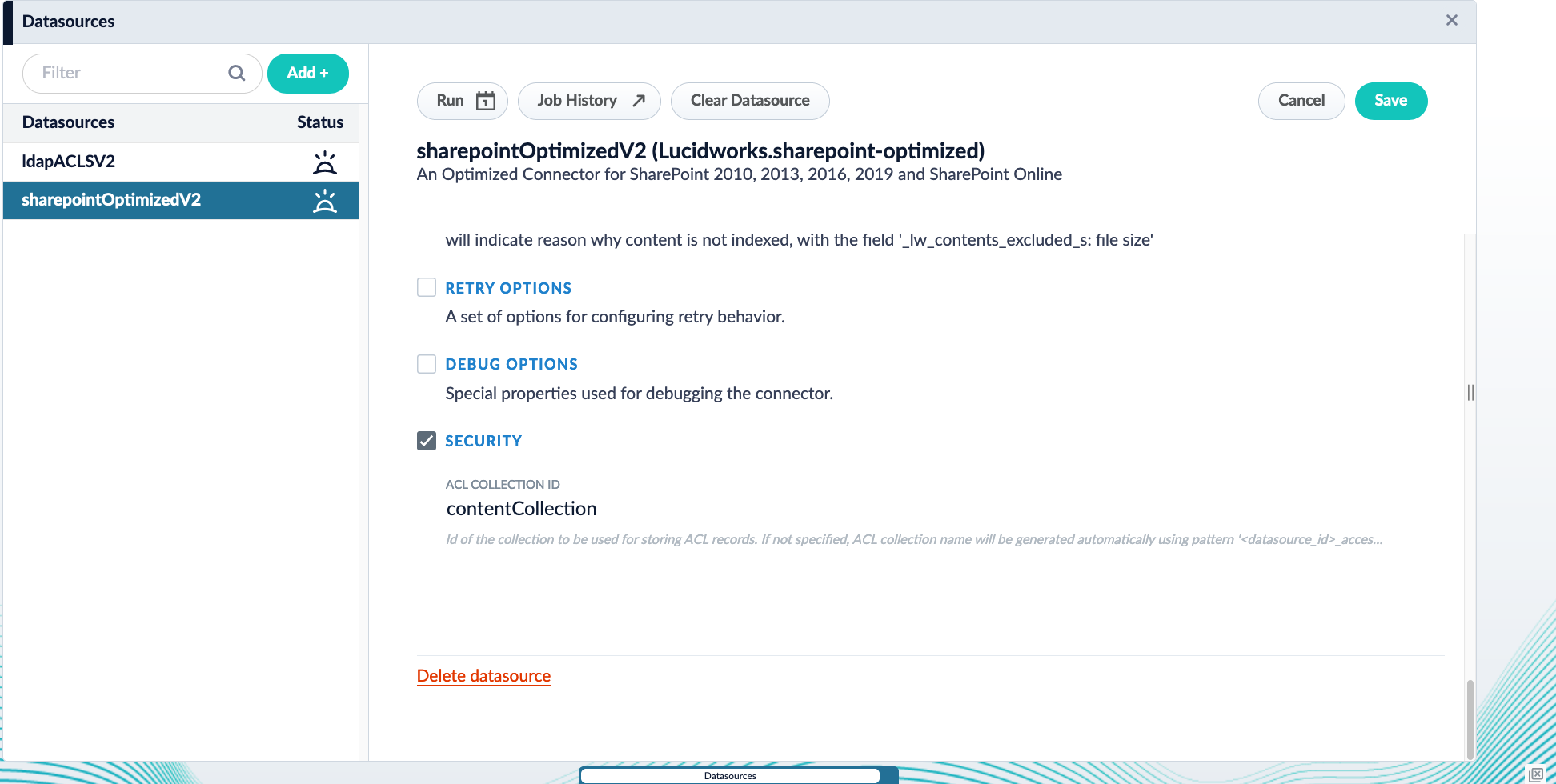
By default, SharePoint Optimized V2 and LDAP ACLs V2 datasources index the content documents and ACL documents to the same collection. Ensure both datasources use the same value, `contentCollection`, for the field **ACL Collection ID**.
If you are using Fusion 5.18.0 or later, you may store ACL documents in a sidecar collection. You must also use SharePoint Optimized V2 and LDAP-ACLs V2 versions 2.0.0 or later to use a separate sidecar collection. Use a separate sidecar collection if you need to manage ACL data independently of the rest of your content.
#### If using SharePoint-Optimized and LDAP-ACLs \< v2.0.0
If you are using SharePoint Optimized V2 and LDAP-ACLs V2 versions before 2.0.0, you must store the content documents and ACL documents in the same collection. Update the **ACL Collection Id** in the datasource configuration.
The SharePoint-Optimized and LDAP-ACLs datasources must index their `content_documents` and `acl_documents` to the same collection. Make sure the property **Security** -> **ACL Collection** in both datasources have the same value. In both datasources, SharePoint-Optimized and LDAP-ACLs, check the property **Security** -> **ACL Collection Id** and make sure it points to the same content-collection.
1. Navigate to **Indexing > Datasources**.
2. Open your SharePoint Optimized V2 or LDAP ACLs V2 datasource.
3. Under **Security**, update the configuration to use `contentCollection` as the **ACL Collection ID**.
The **Security** checkbox must be checked for this field to appear.
4. Save the configuration.
Repeat this process for all required datasources.
#### If using SharePoint-Optimized and LDAP-ACLs >= v2.0.0 with the same collection
Recreate or update the datasources. If only updated, it is not possible to go back to the configuration of a previous plugin version.
By default, the LDAP-ACLs and SharePoint-Optimized V2 datasources index the `content_documents` and `acl_documents` to the same collection.
1. Navigate to **Indexing > Datasources**.
2. Open your SharePoint Optimized V2 or LDAP ACLs V2 datasource.
3. Under **Graph Security Filtering Configuration**, select **Enable security trimming**.
Repeat this process for all required datasources.
#### If using SharePoint-Optimized and LDAP-ACLs >= v2.0.0 with a sidecar collection
Using a sidecar collection for ACL documents requires Fusion 5.18.0 or later.
Recreate or update the datasources. If only updated, it is not possible to go back to the configuration of a previous plugin version.
1. Create a dedicated ACL collection (for example, `acl_collection`).
2. Navigate to **Indexing > Datasources**.
3. Open your SharePoint Optimized V2 or LDAP ACLs datasource.
4. Under **Security**, set **ACL Collection ID** to your ACL collection name (for example, `acl_collection`).
5. Under **Graph Security Filtering Configuration**, select **Enable security trimming**.
6. Save your changes.
If you are transitioning from using the same collection to creating a sidecar collection for ACLs, you must run a full recrawl of your datasource so the ACLs route to the sidecar collection. ACL documents stored in the content collection from before the migration remain in the content collection unless the collection is reindexed or manually cleaned.
After configuring your datasource, you must reference the ACL collection in the graph security trimming query stage.
## Set up Graph Security Trimming
A [Graph Security Trimming stage](/docs/5/fusion/reference/config-ref/pipeline-stages/query-stages/security-trimming-graph-query-stage) is used to pull all nested groups for a user. Then the Solr join query takes those ACL IDs found in the graph query and filters out everything that does not match one of the ACLs.
1. Navigate to **Querying** > **Query Pipelines**.
2. Open the query pipeline associated with your SharePoint Optimized V2 or LDAP ACLs V2 data.
3. Click **Add a new pipeline stage** and select **Graph Security Trimming**.
4. Configure the stage with the following settings:
| | |
| ------------------ | --------------------------------- |
| Field | Value |
| **User ID source** | `query_param` or `header` |
| **User ID key** | The key that contains the User ID |
5. If you are using Fusion 5.9.3 or earlier, configure the following additional fields, which were removed in Fusion 5.9.4:
| Field | Value |
| ----------------------- | ------------------- |
| **ACL solr collection** | `contentCollection` |
| **Join method** | `topLevelDV` |
| **Join Field** | `_lw_acl_ss` |
6. If you are using a sidecar collection in Fusion 5.18.0 or later that contains your access control lists, configure the following additional fields, replacing `acl_collection` with the name of your dedicated ACL collection:
| Field | Value |
| ----------------------- | ----------------- |
| **ACL solr collection** | `acl_collection` |
| **Join method** | `crossCollection` |
| **Join Field** | `id` |
7. Save your changes.
## Test the configuration
To confirm that security trimming works as configured, run the following test:
1. First, run the SharePoint Optimized V2 and LDAP ACLs V2 datasources.
2. Run a series of queries to test user permissions are working as intended:
1. Run a query using a User ID key with no permissions. You should see no search results.
2. Run a query using a User ID key that has access to some documents. You should see some search results.
3. Run a query using a User ID key that has access to all documents. You should see all documents.
Facet by `_lw_document_type_s: contentDocument` to see only the SharePoint docs, otherwise aclDocuments will be also shown.
This describes how to migrate your pre-Fusion 5.8 Graph Security Trimming query pipeline stage setup to Fusion 5.8 or later. It applies to deployments using:
* SharePoint Optimized V2 connector v1.1.0 or later
* LDAP ACLs V2 connector v1.4.0 or later to crawl Active Directory in Azure
* The LDAP ACLs V2 connector v1.2.0 or later to crawl Active Directory in LDAP
## Migration
To migrate a deployment that is crawling Active Directory to Fusion 5.8 or later, follow these steps.
### Update the datasource configurations
The SharePoint Optimized V2 and LDAP ACLs V2 datasources must index the content documents and ACL documents to the same collection. Ensure both datasources use the same value, `contentCollection`, for the field **ACL Collection ID**.
#### If using SharePoint-Optimized and LDAP-ACLs \< v2.0.0
Update the **ACL Collection Id** in the datasource configuration.
The SharePoint-Optimized and LDAP-ACLs datasources must index their `content_documents` and `acl_documents` to the same collection. Make sure the property **Security** -> **ACL Collection** in both datasources have the same value. In both datasources, SharePoint-Optimized and LDAP-ACLs, check the property **Security** -> **ACL Collection Id** and make sure it points to the same content-collection.
1. Navigate to **Indexing > Datasources**.
2. Open your SharePoint Optimized V2 or LDAP ACLs V2 datasource.
3. Under **Security**, update the configuration to use `contentCollection` as the **ACL Collection ID**. The **Security** checkbox must be checked for this field to appear.
4. Save the configuration.
Repeat this process for all required datasources.
#### If using SharePoint-Optimized and LDAP-ACLs >= v2.0.0
Recreate or update the datasources. If only updated, it is not possible to go back to the configuration of a previous plugin version.
By default, the LDAP-ACLs and SharePoint-Optimized V2 datasources will index the `content_documents` and `acl_documents` to the same collection.
1. Navigate to **Indexing > Datasources**.
2. Open your SharePoint Optimized V2 or LDAP ACLs V2 datasource.
3. Under **Graph Security Filtering Configuration**, select **Enable security trimming**.
Repeat this process for all required datasources.
### Clear the datasources and perform a full crawl
1. Navigate to **Indexing > Datasources**.
2. Open your SharePoint Optimized V2 or LDAP ACLs V2 datasource.
3. Click the **Clear Datasource** button, and choose yes.
4. Navigate to **Collections > Collections Manager**.
5. Verify that the `job_state` collection is empty.
6. Return to your datasource.
7. Click **Run > Start** to reindex your data.
Repeat this process for all required datasources.
The quick learning for **Configuring Graph Security Trimming** focuses on how to set up security trimming.
## Query pipeline stage condition examples
Stages can be triggered conditionally when a script in the **Condition** field evaluates to true.
Some examples are shown below.
Run this stage only for mobile clients:
```js wrap theme={"dark"}
params.deviceType === "mobile"
```
Run this stage when debugging is enabled:
```js wrap theme={"dark"}
params.debug === "true"
```
Run this stage when the query includes a specific term:
```js wrap theme={"dark"}
params.q && params.q.includes("sale")
```
Run this stage when multiple conditions are met:
```js wrap theme={"dark"}
request.hasParam("fusion-user-name") && request.getFirstParam("fusion-user-name").equals("SuperUser");
!request.hasParam("isFusionPluginQuery")
```
The first condition checks that the request parameter "fusion-user-name" is present and has the value "SuperUser".
The second condition checks that the request parameter "isFusionPluginQuery" is not present.
## Configuration
When entering configuration values in the UI, use *unescaped* characters, such as `\t` for the tab character. When entering configuration values in the API, use *escaped* characters, such as `\\t` for the tab character.