> ## Documentation Index
> Fetch the complete documentation index at: https://doc.lucidworks.com/llms.txt
> Use this file to discover all available pages before exploring further.
# JDBC Lookup Stage
export const schema = {
"type": "object",
"title": "JDBC Lookup",
"description": "Connects to a database via JDBC, executes a parameterized SQL query, and injects the result values into the query context or request.",
"required": ["driver", "connection", "username", "password", "preparedStatement"],
"properties": {
"skip": {
"type": "boolean",
"title": "Skip This Stage",
"description": "Controls whether this stage executes during pipeline processing at runtime. When set to `true`, the stage is completely bypassed and documents pass through unchanged to the next stage. Useful for A/B testing, gradual rollouts, or temporarily disabling a stage without removing it from the pipeline.",
"default": false,
"hints": ["advanced"]
},
"label": {
"type": "string",
"title": "Label",
"description": "Human-readable identifier displayed in the Fusion Admin UI, monitoring dashboards, and log messages. Use descriptive labels like `Parse Product PDFs` to aid debugging and team collaboration. Labels appear in performance metrics and error reports, making it easier to identify which stage failed.",
"hints": ["advanced"],
"maxLength": 255
},
"condition": {
"type": "string",
"title": "Condition",
"description": "JavaScript expression evaluated at runtime on each document to conditionally execute this stage. The expression must return `true` to execute or `false` to skip. Access document fields using `doc.getFieldValue('fieldName')` and request parameters via `request.getFirstParam('paramName')`. For example, `doc.getFieldValue('type') === 'premium'` executes this stage only for premium content.",
"hints": ["code", "code/javascript", "advanced"]
},
"legacy": {
"type": "boolean",
"title": "Legacy",
"description": "When `true`, this stage operates in legacy mode only.",
"hints": ["readonly", "hidden"]
},
"asyncConfig": {
"type": "object",
"title": "Asynchronous Execution Config",
"required": ["enabled", "asyncId"],
"properties": {
"enabled": {
"type": "boolean",
"title": "Enable Async Execution",
"description": "Run the expensive data loading or processing part of this stage in a separate thread allowing the pipeline to continue executing. The results of this asynchronous execution can be merged into the pipeline request using a downstream Merge Async Results stage.",
"default": false
},
"asyncId": {
"type": "string",
"title": "Async ID",
"description": "A unique value to use as reference in downstream Merge Async Results stages."
}
}
},
"driver": {
"type": "string",
"title": "JDBC Driver",
"description": "Specifies the fully qualified Java class name of the JDBC driver, such as `com.mysql.cj.jdbc.Driver` for MySQL."
},
"connection": {
"type": "string",
"title": "Connection URI",
"description": "Specifies the JDBC connection string including host, port, and database name, such as `jdbc:postgresql://localhost:5432/mydb`."
},
"username": {
"type": "string",
"title": "Username",
"description": "Specifies the username used to authenticate the JDBC connection."
},
"password": {
"type": "string",
"title": "Password",
"description": "Specifies the password used to authenticate the JDBC connection.",
"hints": ["secret"]
},
"preparedStatement": {
"type": "string",
"title": "SQL Prepared Statement",
"description": "Specifies the parameterized SQL statement to execute. Use `?` placeholders for values bound from request or context keys.",
"hints": ["lengthy"]
},
"rows": {
"type": "integer",
"title": "Rows",
"description": "Sets the maximum number of rows returned from the query.",
"default": 10,
"hints": ["advanced"]
},
"join": {
"type": "boolean",
"title": "Join With Request",
"description": "When `true`, adds results to the request using the prefix key and row ID. When `false`, stores results in the pipeline context. Do not use with asynchronous execution.",
"default": true,
"hints": ["advanced"]
},
"preparedStatementKeys": {
"type": "array",
"title": "Prepared Statement Keys",
"description": "Specifies the request, header, or context keys mapped to the `?` placeholders in the prepared statement, in order.",
"hints": ["advanced"],
"items": {
"type": "string"
}
},
"prefix": {
"type": "string",
"title": "Result Prefix Key",
"description": "Specifies a string prepended to result field names to namespace them and avoid collisions, for example `db_` to produce `db_title`.",
"hints": ["advanced"]
},
"fetchSize": {
"type": "integer",
"title": "Fetch Size",
"description": "Sets the JDBC fetch size controlling how many rows the driver retrieves at once. Use `-1` to apply the driver default.",
"default": -1,
"hints": ["advanced"]
},
"validationQueryTimeout": {
"type": "integer",
"title": "Validation Query Timeout",
"description": "Sets the timeout in seconds for connection validation queries. Use `0` or a negative value to disable the timeout.",
"default": -1,
"hints": ["advanced"]
}
},
"category": "Fetch Data",
"categoryPriority": 6,
"unsafe": false
};
export const SchemaParamFields = ({schema}) => {
const sanitize = str => {
if (typeof str !== "string") return str;
return str.replace(/^"(.*)"$/s, "$1").replace(/\\/g, "").replace(/"/g, "'");
};
const renderMd = str => {
const s = sanitize(str);
const text = (/[.!?]\)*$/).test(s) ? s : `${s}.`;
return text.split(/(\*\*[^*]+\*\*|_[^_]+_|`[^`]+`)/g).map((part, i) => {
if (part.startsWith("**")) return {part.slice(2, -2)};
if (part.startsWith("_")) return {part.slice(1, -1)};
if (part.startsWith("`")) return {part.slice(1, -1)};
return part;
});
};
const {description, properties = {}, required: requiredProps = []} = schema;
const visibleProps = useMemo(() => Object.entries(properties).filter(([, prop]) => !prop.hints?.includes("hidden")), [properties]);
const renderProp = ([name, prop]) => {
const isRequired = requiredProps.includes(name);
const hasDefault = prop.default !== undefined;
const rawDefault = prop.default;
const hints = prop.hints || [];
const isComplexDefault = hasDefault && (typeof rawDefault === "object" || typeof rawDefault === "string" && (rawDefault.length > 20 || rawDefault.includes('"')));
const postBadges = [];
if (prop.title) {
postBadges.push(<>API property: {name});
}
const constraints = [];
if (prop.minimum !== undefined && prop.maximum !== undefined) {
constraints.push(`Range: ${prop.minimum} – ${prop.maximum}`);
} else if (prop.minimum !== undefined) {
constraints.push(`Min: ${prop.minimum}`);
} else if (prop.maximum !== undefined) {
constraints.push(`Max: ${prop.maximum}`);
}
if (prop.minLength !== undefined && prop.maxLength !== undefined) {
constraints.push(`Length: ${prop.minLength} – ${prop.maxLength}`);
} else if (prop.minLength !== undefined) {
constraints.push(`Min length: ${prop.minLength}`);
} else if (prop.maxLength !== undefined) {
constraints.push(`Max length: ${prop.maxLength}`);
}
const fieldProps = {
key: name,
body: prop.title || name,
type: prop.type,
...postBadges.length > 0 && ({
post: postBadges
}),
...isRequired && ({
required: true
}),
...!isComplexDefault && hasDefault ? {
default: sanitize(String(rawDefault))
} : {}
};
const isObject = prop.type === "object" && prop.properties;
const isArrayOfObjects = prop.type === "array" && prop.items?.type === "object" && prop.items.properties;
return
{prop.description &&
{isLoaded && `
}} />}
Powered by Lucidworks Agent Studio
;
};
[localhost link]: http://localhost:3000/docs/5/fusion/reference/config-ref/pipeline-stages/query-stages/jdbc-query-stage
[mintlify link]: https://doc.lucidworks.com/docs/5/fusion/reference/config-ref/pipeline-stages/query-stages/jdbc-query-stage
[old doc.lw link]: https://doc.lucidworks.com/fusion/5.9/260
The JDBC Lookup query pipeline stage is used to call out to a database as part of a pipeline stage, to inject results into either the context/request or the pipeline document.
For example, if you needed to look up a user from a DB and add their profile information onto a request for downstream use in a pipeline, the JDBC Lookup Stage would facilitate this.
You must first upload a JDBC Driver to Fusion.
The JDBC V2 connector is supported, and fetches documents from a relational database via SQL queries. Under the hood, this connector implements the Solr [DataImportHandler (DIH)](https://wiki.apache.org/solr/DataImportHandler) plugin.
Fusion stores JDBC drivers in the blob store. You can upload a driver using the Fusion UI or the Blob Store API.
## How to upload a JDBC driver using the Fusion UI
{/* // tag::upload[] */}
1. In the Fusion UI, navigate to **System** > **Blobs**.
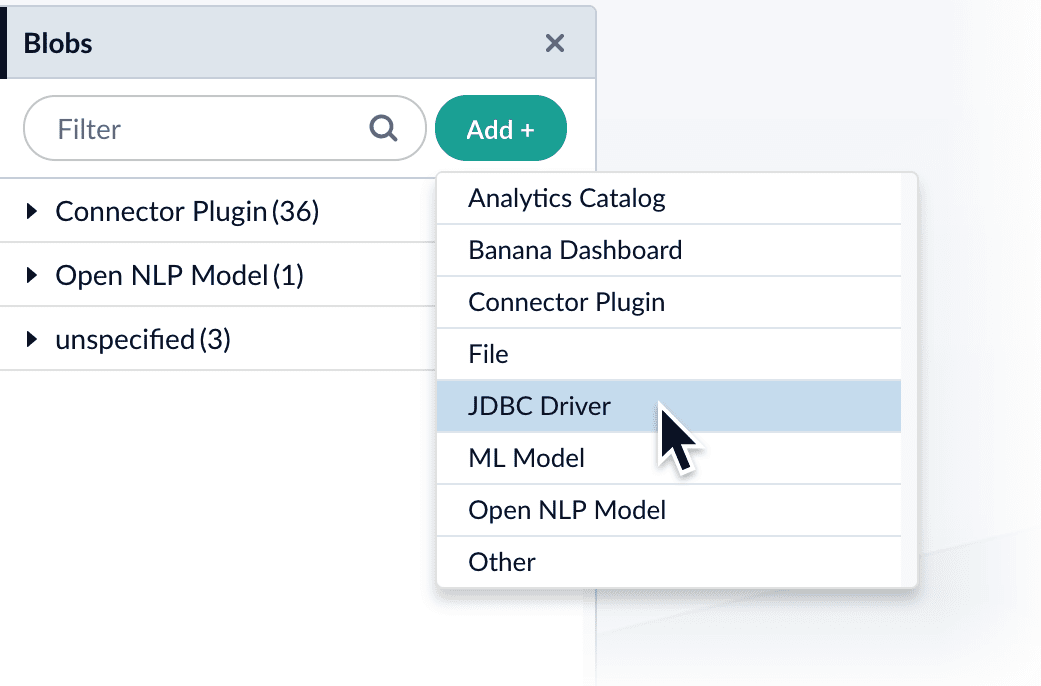
2. Click **Add**.
3. Select **JDBC Driver**.\
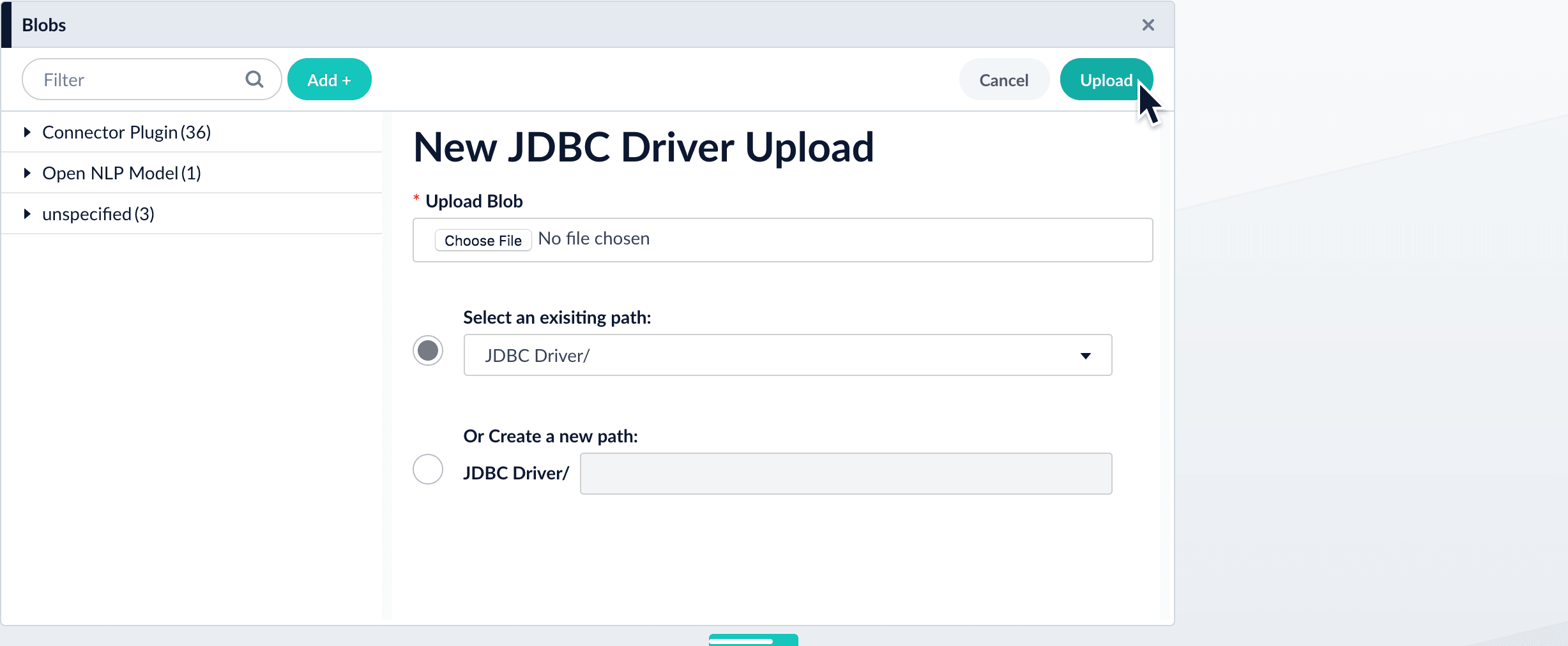
The "New 'JDBC Driver' Upload" panel appears.
4. Click **Choose File** and select the .jar file from your file system.
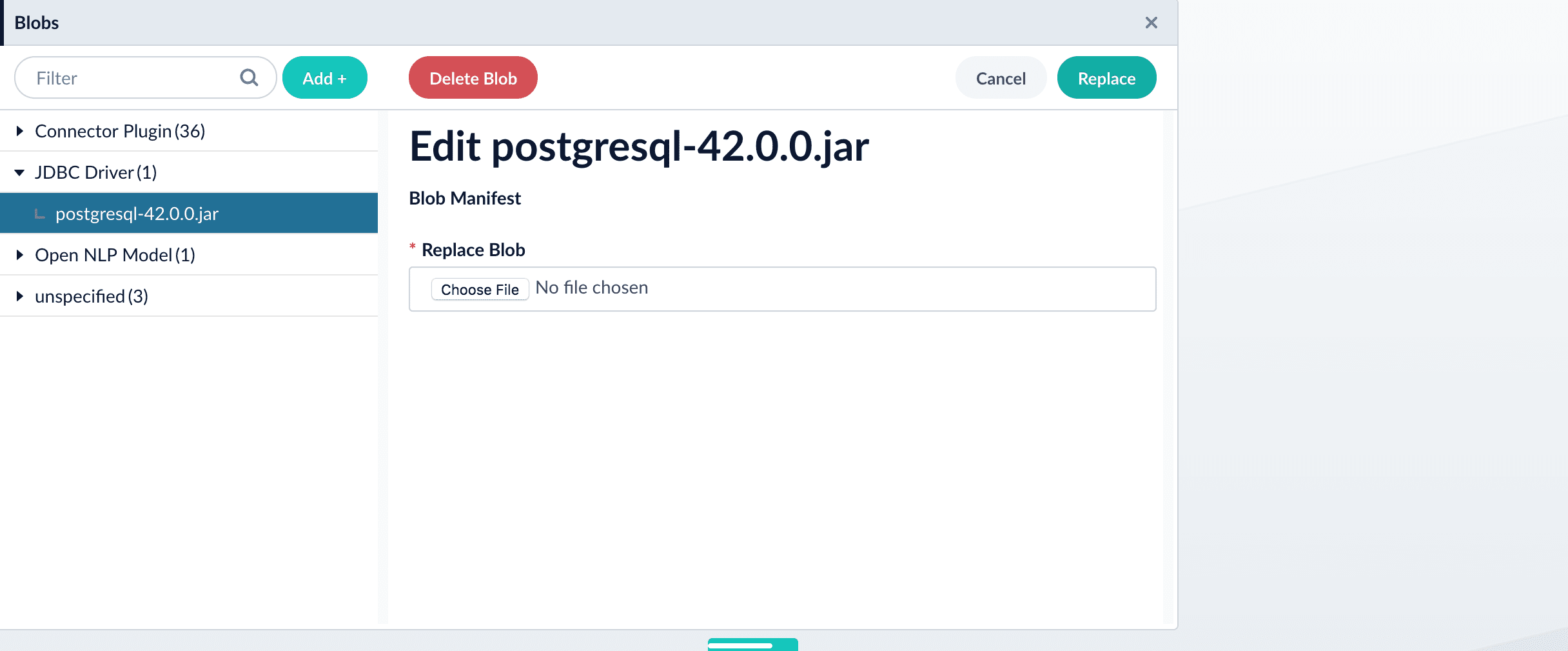
5. Click **Upload**.\
The new driver’s blob manifest appears.
From this screen you can also delete or replace the driver.
{/* // end::upload[] */}
## How to install a JDBC driver using the API
1. Upload the JAR file to Fusion’s blob store using the [`/blobs/{id}` endpoint](/api-reference/blobs/upload-a-blob).
Specify an arbitrary blob ID, and a `resourceType` value of `plugin:connector`, as in this example:
```bash theme={"dark"}
curl -u USERNAME:PASSWORD -H "content-type:application/java-archive" -H "content-length:707261" -X PUT --data-binary @postgresql-42.0.0.jar http://localhost:8764/api/blobs/mydriver?resourceType=driver:jdbc
```
Success response:
```json theme={"dark"}
{
"name" : "mydriver",
"contentType" : "application/java-archive",
"size" : 707261,
"modifiedTime" : "2017-06-09T19:00:48.919Z",
"version" : 0,
"md5" : "c67163ca764bfe632f28229c142131b5",
"metadata" : {
"subtype" : "driver:jdbc",
"drivers" : "org.postgresql.Driver",
"resourceType" : "driver:jdbc"
}
}
```
Fusion automatically publishes the event to the cluster, and the listeners perform the driver installation process on each node.
If the blob ID is identical to an existing one, the old driver will be uninstalled and the new driver will installed in its place. To get the list of existing blob IDs, run: `curl -u USERNAME:PASSWORD https://FUSION_HOST:FUSION_PORT/api/blobs`
2. To verify the uploaded driver, run:
```bash theme={"dark"}
curl -u USERNAME:PASSWORD https://FUSION_HOST:FUSION_PORT/api/blobs/BLOB_ID/manifest
```
Where the `BLOB_ID` is the name specified during upload, such as "mydriver" above. A success response looks like this:
```json theme={"dark"}
{
"name" : "mydriver",
"contentType" : "application/java-archive",
"size" : 707261,
"modifiedTime" : "2017-06-09T19:05:17.897Z",
"version" : 1569755095787110400,
"md5" : "c67163ca764bfe632f28229c142131b5",
"metadata" : {
"subtype" : "driver:jdbc",
"drivers" : "org.postgresql.Driver",
"resourceType" : "driver:jdbc"
}
}
```
This stage supports [asynchronous processing](/docs/5/fusion/getting-data-out/query-basics/query-pipelines/overview).
## Stage configuration example
An example of setup for a JDBC Lookup query pipeline stage.
*Upload stage config via POST to Fusion REST API endpoint `api/query-stages/instances`*
```bash wrap theme={"dark"}
curl -u USERNAME:PASSWORD -X POST -H "Content-Type: application/json" -d '{"id": "jdbc-quer","type":"jdbc-query-lookup","driver":"postgresql-9.3-1101-jdbc4.jar","connection":"jdbc:postgresql:database","username":"user","password":"password1","preparedStatement":"select ID as id from DATABASE;"}' http://FUSION_HOST:FUSION_PORT/api/query-stages/instances
```
*Response*
```json wrap theme={"dark"}
{
"type" : "jdbc-query-lookup",
"id" : "jdbc-quer",
"driver" : "postgresql-9.3-1101-jdbc4.jar",
"connection" : "jdbc:postgresql:database",
"username" : "user",
"password" : "password1",
"preparedStatement" : "select ID as id from DATABASE;",
"fetchSize" : -1,
"join" : true,
"rows" : 10,
"skip" : false,
"label" : "jdbc-query-lookup",
"type" : "jdbc-query-lookup"
}
```
## Query pipeline stage condition examples
Stages can be triggered conditionally when a script in the **Condition** field evaluates to true.
Some examples are shown below.
Run this stage only for mobile clients:
```js wrap theme={"dark"}
params.deviceType === "mobile"
```
Run this stage when debugging is enabled:
```js wrap theme={"dark"}
params.debug === "true"
```
Run this stage when the query includes a specific term:
```js wrap theme={"dark"}
params.q && params.q.includes("sale")
```
Run this stage when multiple conditions are met:
```js wrap theme={"dark"}
request.hasParam("fusion-user-name") && request.getFirstParam("fusion-user-name").equals("SuperUser");
!request.hasParam("isFusionPluginQuery")
```
The first condition checks that the request parameter "fusion-user-name" is present and has the value "SuperUser".
The second condition checks that the request parameter "isFusionPluginQuery" is not present.
## Configuration
When entering configuration values in the UI, use *unescaped* characters, such as `\t` for the tab character. When entering configuration values in the API, use *escaped* characters, such as `\\t` for the tab character.
 4. Click **Choose File** and select the .jar file from your file system.
 5. Click **Upload**.\
The new driver’s blob manifest appears.
5. Click **Upload**.\
The new driver’s blob manifest appears.
 From this screen you can also delete or replace the driver.
{/* // end::upload[] */}
## How to install a JDBC driver using the API
1. Upload the JAR file to Fusion’s blob store using the [`/blobs/{id}` endpoint](/api-reference/blobs/upload-a-blob).
Specify an arbitrary blob ID, and a `resourceType` value of `plugin:connector`, as in this example:
```bash theme={"dark"}
curl -u USERNAME:PASSWORD -H "content-type:application/java-archive" -H "content-length:707261" -X PUT --data-binary @postgresql-42.0.0.jar http://localhost:8764/api/blobs/mydriver?resourceType=driver:jdbc
```
Success response:
```json theme={"dark"}
{
"name" : "mydriver",
"contentType" : "application/java-archive",
"size" : 707261,
"modifiedTime" : "2017-06-09T19:00:48.919Z",
"version" : 0,
"md5" : "c67163ca764bfe632f28229c142131b5",
"metadata" : {
"subtype" : "driver:jdbc",
"drivers" : "org.postgresql.Driver",
"resourceType" : "driver:jdbc"
}
}
```
Fusion automatically publishes the event to the cluster, and the listeners perform the driver installation process on each node.
From this screen you can also delete or replace the driver.
{/* // end::upload[] */}
## How to install a JDBC driver using the API
1. Upload the JAR file to Fusion’s blob store using the [`/blobs/{id}` endpoint](/api-reference/blobs/upload-a-blob).
Specify an arbitrary blob ID, and a `resourceType` value of `plugin:connector`, as in this example:
```bash theme={"dark"}
curl -u USERNAME:PASSWORD -H "content-type:application/java-archive" -H "content-length:707261" -X PUT --data-binary @postgresql-42.0.0.jar http://localhost:8764/api/blobs/mydriver?resourceType=driver:jdbc
```
Success response:
```json theme={"dark"}
{
"name" : "mydriver",
"contentType" : "application/java-archive",
"size" : 707261,
"modifiedTime" : "2017-06-09T19:00:48.919Z",
"version" : 0,
"md5" : "c67163ca764bfe632f28229c142131b5",
"metadata" : {
"subtype" : "driver:jdbc",
"drivers" : "org.postgresql.Driver",
"resourceType" : "driver:jdbc"
}
}
```
Fusion automatically publishes the event to the cluster, and the listeners perform the driver installation process on each node.